Showing posts with label painting. Show all posts

Saturday, October 13, 2012

Gustav Klimt


Early life & education


Gustav Klimt was born in Baumgarten, near Vienna, the second of seven children — three boys and four girls. All three sons displayed artistic talent early on. His father, Ernst Klimt, formerly from Bohemia, was a gold engraver. Ernst married Anna Klimt (née Finster), whose unrealized ambition was to be a musical performer. Klimt lived in poverty for most of his childhood, as work was scarce and the economy difficult for immigrants.
In 1876, Klimt was enrolled in the Vienna School of Arts and Crafts (Kunstgewerbeschule), where he studied until 1883, and received training as an architectural painter. He revered the foremost history painter of the time, Hans Makart. Unlike many young artists, Klimt accepted the principles of conservative Academic training. In 1877 his brother Ernst, who, like his father, would become an engraver, also enrolled in the school. The two brothers and their friend Franz Matsch began working together; by 1880 they had received numerous commissions as a team they called the "Company of Artists". Klimt began his professional career painting interior murals and ceilings in large public buildings on the Ringstraße including a successful series of "Allegories and Emblems".
In 1888, Klimt received the Golden order of Merit from Emperor Franz Josef I of Austria for his contributions to art. He also became an honorary member of the University of Munich and the University of Vienna. In 1892 both Klimt's father and brother Ernst died, and he had to assume financial responsibility for his father's and brother's family. The tragedies affected his artistic vision as well, and soon he would veer toward a new personal style. In the early 1890s, Klimt met Emilie Flöge, who, notwithstanding the artist's relationships with other women, was to be his companion until the end of his life. Whether his relationship with Flöge was sexual or not is debated, but during that period Klimt fathered at least 14 children.
Vienna secession years
Klimt became one of the founding members and president of the Wiener Sezession (Vienna Secession) in 1897 and of the group's periodical Ver Sacrum (Sacred Spring). He remained with the Secession until 1908. The group's goals were to provide exhibitions for unconventional young artists, to bring the best foreign artists works to Vienna, and to publish its own magazine to showcase members' work.The group declared no manifesto and did not set out to encourage any particular style -- Naturalists, Realists, and Symbolists all coexisted. The government supported their efforts and gave them a lease on public land to erect an exhibition hall. The group's symbol was Pallas Athena, the Greek goddess of just causes, wisdom, and the arts -- and Klimt painted his radical version in 1898.
Beginning in the late 1890s Klimt took annual summer holidays with the Flöge family on the shores of Attersee and painted many of his landscapes there. These works constitute the only genre aside from the figure that seriously interested Klimt, and are of a number and quality so as to merit a separate appreciation. Formally, the landscapes are characterized by the same refinement of design and emphatic patterning as the figural pieces. Deep space in the Attersee works is so efficiently flattened to a single plane, it is believed that Klimt painted them while looking through a telescope.
In 1894, Klimt was commissioned to create three paintings to decorate the ceiling of the Great Hall in the University of Vienna. Not completed until the turn of the century, his three paintings, Philosophy, Medicine and Jurisprudence were criticized for their radical themes and material, which was called "pornographic". Klimt had transformed traditional allegory and symbolism into a new language which was more overtly sexual, and hence more disturbing. The public outcry came from all quarters — political, aesthetic, and religious. As a result, they were not displayed on the ceiling of the Great Hall. This would be the last public commission accepted by the artist. All three paintings were destroyed by retreating SS forces in May 1945. His Nuda Verita (1899) defined his bid to further shake up the establishment. The starkly naked red-headed woman holds the mirror of truth, while above it is a quote by Schiller in stylized lettering, "If you cannot please everyone with your deeds and your art, please a few. To please many is bad."
In 1902, Klimt finished the Beethoven Frieze for the 14th Vienna Secessionist exhibition, which was intended to be a celebration of the composer and featured a monumental, polychromed sculpture by Max Klinger. Meant for the exhibition only, the frieze was painted directly on the walls with light materials. After the exhibition the painting was preserved, although it did not go on display until 1986.
Golden phase and critical success
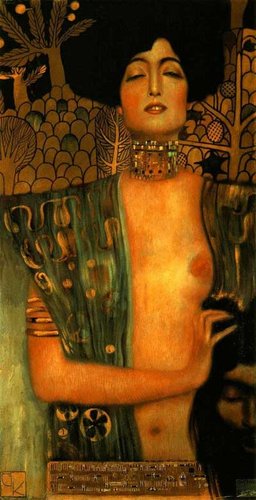
Klimt's 'Golden Phase' was marked by positive critical reaction and success. Many of his paintings from this period utilized gold leaf; the prominent use of gold can first be traced back to Pallas Athene (1898) and Judith I (1901), although the works most popularly associated with this period are the Portrait of Adele Bloch-Bauer I (1907) and The Kiss (1907 - 1908). Klimt traveled little but trips to Venice and Ravenna, both famous for their beautiful mosaics, most likely inspired his gold technique and his Byzantine imagery. In 1904, he collaborated with other artists on the lavish Palais Stoclet, the home of a wealthy Belgian industrialist, which was one of the grandest monuments of the Art Nouveau age. Klimt's contributions to the dining room, including both Fulfillment and Expectation, were some of his finest decorative work, and as he publicly stated, "probably the ultimate stage of my development of ornament." Between 1907 and 1909, Klimt painted five canvases of society women wrapped in fur. His apparent love of costume is expressed in the many photographs of Flöge modeling clothing she designed.
As he worked and relaxed in his home, Klimt normally wore sandals and a long robe with no undergarments. His simple life was somewhat cloistered, devoted to his art and family and little else except the Secessionist Movement, and he avoided café society and other artists socially. Klimt's fame usually brought patrons to his door, and he could afford to be highly selective. His painting method was very deliberate and painstaking at times and he required lengthy sittings by his subjects. Though very active sexually, he kept his affairs discreet and he avoided personal scandal. Like Rodin, Klimt also utilized mythology and allegory to thinly disguise his highly erotic nature, and his drawings often reveal purely sexual interest in women as objects. His models were routinely available to him to pose in any erotic manner that pleased him. Many of the models were prostitutes as well.
Klimt wrote little about his vision or his methods. He wrote mostly postcards to Flöge and kept no diary. In a rare writing called "Commentary on a non-existent self-portrait", he states "I have never painted a self-portrait. I am less interested in myself as a subject for a painting than I am in other people, above all women...There is nothing special about me. I am a painter who paints day after day from morning to night...Who ever wants to know something about me... ought to look carefully at my pictures."
Later life & posthumous success
In 1911 his painting Death and Life received first prize in the world exhibitions in Rome. In 1915 his mother Anna died. Klimt died three years later in Vienna on February 6, 1918, having suffered a stroke and pneumonia. He was interred at the Hietzing Cemetery in Vienna. Numerous paintings were left unfinished.

Style & recurring themes
Klimt's work is distinguished by the elegant gold or coloured decoration, often of a phallic shape that conceals the more erotic positions of the drawings upon which many of his paintings are based. This can be seen in Judith I (1901), and in The Kiss (1907–1908), and especially in Danaë (1907). One of the most common themes Klimt utilized was that of the dominant woman, the femme fatale. Art historians note an eclectic range of influences contributing to Klimt's distinct style, including Egyptian, Minoan, Classical Greek, and Byzantine inspirations. Klimt was also inspired by the engravings of Albrecht Dürer, late medieval European painting, and Japanese Rimpa school. His mature works are characterized by a rejection of earlier naturalistic styles, and make use of symbols or symbolic elements to convey psychological ideas and emphasize the "freedom" of art from traditional culture.

Sunday, September 30, 2012

Fauvism


Fauvism and
the Wild Beasts of Early 20th Century Art

the small group of artists who, shortly after the turn of the century, exploded onto the scene with a wild, vibrant style of expressionistic art that shocked the critics but has since been recognized as one of the seminal forces that drove modern art.

They were called the fauves, French for "wild beasts", a term of derision used to indicate their apparent lack of discipline.

Today fauvism once thought of as a minor, short-lived, movement, is recognized as having paved the way to both cubism and modern expressionism in its disregard for natural forms and its love of unbridled color.

The Development of Fauvism

In a sense, Fauvism evolved from pointillism which, in turn, had evolved as a development of impressionism. The open-air paintings of the impressionists emphasized the way strong light broke up the uniform color of surfaces into shimmering bits of reflected color. They abandoned the carefully graduated tonal painting of the past and built their pictures with small brush strokes of pure color.

Pointillism took this further by painting with tiny dots of contrasting hues. Seurat, the greatest exponent of pointillism, held that each dot of paint should be accompanied by a weaker dot of its complement. Van Gogh had used some of the same techniques, but with much broader and bolder strokes.

Matisse dabbled in pointillism for awhile, but, his instinct was to make every stroke of his painting strong. He and his group developed a style of broad, short strokes of bright contrasting colors.

The new style that had been evolving for several years burst upon the public in October 1905 at the Salon d'Automne. To the traditionalists, the new style (embodying Derain's ideal of color for color's sake) seemed dangerous.

The paintings were hung together in the central gallery, surrounding a conventional renaissance-style statue. Tradition has it that art critic Louis Vauxcelles remarked of the situation: "Ah, Donatello au millieu des fauves. (Donatello among the wild beasts)" As the impressionists had before them, the fauves happily clung to the name that had been given to them as an insult.

Fauvism Fades as its Practitioners Evolve

By 1907, the major artists in the Fauve camp were beginning to evolve their styles in other directions. The influence of Paul Cezanne was having its effect on most of the artists of the early twentieth century.

In the paintings below, the bright colors and wild brush strokes of fauvism are giving way to the beginnings of the cubist and other modern movements.


Fauvism was the first of the avant-garde movements that flourished in France in the early years of the twentieth century. The Fauve painters were the first to break with Impressionism as well as with older, traditional methods of perception. Their spontaneous, often subjective response to nature was expressed in bold, undisguised brushstrokes and high-keyed, vibrant colors directly from the tube.

Henri Matisse (French, 1869–1954) and André Derain (French, 1880–1954) introduced unnaturalistic color and vivid brushstrokes into their paintings in the summer of 1905, working together in the small fishing port of Collioure on the Mediterranean coast (1975.1.194; 1982.179.29). When their pictures were exhibited later that year at the Salon d'Automne in Paris (Matisse, The Woman with a Hat), they inspired the witty critic Louis Vauxcelles to call them fauves ("wild beasts") in his review for the magazine Gil Blas. This term was later applied to the artists themselves.
The Fauves were a loosely shaped group of artists sharing a similar approach to nature, but they had no definitive program. Their leader was Matisse, who had arrived at the Fauve style after earlier experimenting with the various Post-Impressionist styles of Van Gogh, Gauguin, and Cézanne, and the Neo-Impressionism of Seurat, Cross, and Signac. These influences inspired him to reject traditional three-dimensional space and seek instead a new picture space defined by the movement of color planes (1999.363.38; The Young Sailor I; 1999.363.41).

Another major Fauve was Maurice de Vlaminck (French, 1876–1958), who might be called a "natural" Fauve because his use of highly intense color corresponded to his own exuberant nature. Vlaminck took the final step toward embracing the Fauve style (1999.363.84; 1999.363.83) after seeing the second large retrospective exhibition of Van Gogh's work at the Salon des Indépendants in the spring of 1905, and the Fauve paintings produced by Matisse and Derain in Collioure.

As an artist, Derain occupied a place midway between the impetuous Vlaminck and the more controlled Matisse. He had worked with Vlaminck in Chatou, near Paris, intermittently from 1900 on ("School of Chatou"), and spent the summer of 1905 with Matisse in Collioure. In 1906, he also painted some fifteen scenes of London in a more restrained palette.

Other important Fauvists were Kees van Dongen, Charles Camoin, Henri-Charles Manguin, Othon Friesz, Jean Puy, Louis Valtat, and Georges Rouault. These were joined in 1906 by Georges Braque and Raoul Dufy.

For most of these artists, Fauvism was a transitional, learning stage. By 1908, a revived interest in Paul Cézanne's vision of the order and structure of nature had led many of them to reject the turbulent emotionalism of Fauvism in favor of the logic of Cubism. Braque became the cofounder with Picasso of Cubism. Derain, after a brief flirtation with Cubism, became a widely popular painter in a somewhat neoclassical manner. Matisse alone pursued the course he had pioneered, achieving a sophisticated balance between his own emotions and the world he painted.

The Fauvist movement has been compared to German Expressionism, both projecting brilliant colors and spontaneous brushwork, and indebted to the same late nineteenth-century sources, especially Van Gogh. The French were more concerned with the formal aspects of pictorial organization, while the German Expressionists were more emotionally involved in their subjects.
Between 1901 and 1906, several comprehensive exhibitions were held in Paris, making the work of Vincent van Gogh, Paul Gauguin, and Paul Cézanne widely accessible for the first time. For the painters who saw the achievements of these great artists, the effect was one of liberation and they began to experiment with radical new styles. Fauvism was the first movement of this modern period, in which color ruled supreme.
The advent of Modernism is often dated by the appearance of the Fauves in Paris at the Salon d'Automne in 1905. Their style of painting, using non-naturalistic colors, was one of the first avant-garde developments in European art. They greatly admired van Gogh, who said of his own work: ``Instead of trying to render what I see before me, I use color in a completely arbitrary way to express myself powerfully''. The Fauvists carried this idea further, translating their feelings into color with a rough, almost clumsy style. Matisse was a dominant figure in the movement; other Fauvists included Vlaminck, Derain, Marquet, and Rouault. However, they did not form a cohesive group and by 1908 a number of painters had seceded to Cubism.
Fauvism was a short-lived movement, lasting only as long as its originator, Henri Matisse (1869-1954), fought to find the artistic freedom he needed. Matisse had to make color serve his art, rather as Gauguin needed to paint the sand pink to express an emotion. The Fauvists believed absolutely in color as an emotional force. With Matisse and his friends, Maurice de Vlaminck (1876-1958) and André Derain (1880-1954), color lost its descriptive qualities and became luminous, creating light rather than imitating it. They astonished viewers at the 1905 Salon d'Automne: the art critic Louis Vauxcelles saw their bold paintings surrounding a conventional sculpture of a young boy, and remarked that it was like a Donatello ``parmi les fauves'' (among the wild beasts). The painterly freedom of the Fauves and their expressive use of color gave splendid proof of their intelligent study of van Gogh's art. But their art seemed brasher than anything seen before.
During its brief flourishing, Fauvism had some notable adherents, including Rouault, Dufy, and Braque. Vlaminck had a touch of his internal moods: even if The River (c. 1910; 60 x 73 cm (23 1/2 x 28 3/4 in)) looks at peace, we feel a storm is coming. A self-professed ``primitive'', he ignored the wealth of art in the Louvre, preferring to collect the African masks that became so important to early 20th-century art.
Derain also showed a primitive wildness in his Fauve period-- Charing Cross Bridge (1906; 80 x 100 cm (32 x 39 in)) bestrides a strangely tropical London-- though as he aged he quenched his fire to a classic calm. He shared a studio with Vlaminck for a while and The River and Charing Cross Bridge seem to share a vibrant power: both reveal an unselfconscious use of color and shape, a delight in the sheer patterning of things. This may not be profound art but it does give visual pleasure.